 Skip to content
If you live in Southern California, palm trees are an inescapable and iconic part of your daily landscape. From the towering Mexican Fan Palms lining the boulevards of the San Fernando Valley to the elegant Queen Palms gracing residential backyards in Pasadena, these tropical staples are everywhere.
However, homeowners often notice something alarming: the trunks of their palm trees appear to be peeling, cracking, or shedding large fibrous chunks. This naturally leads to a very common question: Do palm trees shed their bark?
The short answer is no, because palm trees do not actually have bark in the traditional sense.
To understand why your palm tree looks like it’s peeling—and to know whether it requires professional maintenance or if it’s suffering from a disease—we have to look at the unique, fascinating biology of these iconic plants.
The Anatomy of a Palm Tree: Not Your Average Tree
The most crucial thing to understand about palm trees is that, botanically speaking, they are not actually trees at all.
Oaks, maples, and pine trees are classified as “dicots.” They possess a layer of cells just beneath their bark called the cambium. This layer allows the tree to grow outward, adding annual rings of wood and generating a protective outer layer of true bark. If you damage the bark of a dicot tree, it can cause severe harm or even kill the tree by cutting off its vascular system.
Palm trees, on the other hand, are “monocots.” They are biologically much closer to giant ornamental grasses or bamboo than they are to an oak tree. A palm tree’s trunk consists of fibrous vascular bundles distributed throughout a spongy interior, rather than arranged in distinct outer rings.
Because they are monocots, palm trees do not produce cambium, they do not grow annual tree rings, and they absolutely do not produce bark.
So, What is Peeling Off My Palm Tree?
If it isn’t bark, what are those rough, peeling, and sometimes spiky layers on the outside of the trunk?
What you are looking at are the remnants of old palm fronds. As a palm tree grows, it produces new fronds (leaves) from the central growing point at the very top, known as the apical meristem or “heart.” As these new, green fronds emerge and reach for the sun, the older, lower fronds eventually die off.
When these old fronds die, the base of the leaf stalk—often called a “boot” or petiole base—remains attached to the trunk. Over time, depending on the exact species of the palm, these boots will dry out, crack, and eventually slough off.
Some species, like the King Palm or Royal Palm, are considered “self-cleaning.” As detailed by botanical experts at the University of Florida’s Institute of Food and Agricultural Sciences (IFAS), self-cleaning palms will naturally drop their dead fronds and boots cleanly, leaving behind a smooth, green, or gray trunk without any human intervention.
However, many of the most common palms in Los Angeles, such as the Mexican Fan Palm or the California Fan Palm, are not self-cleaning. Their dead fronds form a thick, highly flammable “skirt” or “petticoat” around the trunk, and the boots remain stubbornly attached for years, slowly fraying and peeling in a way that looks exactly like shedding bark.
The Difference Between Shedding and Skinning
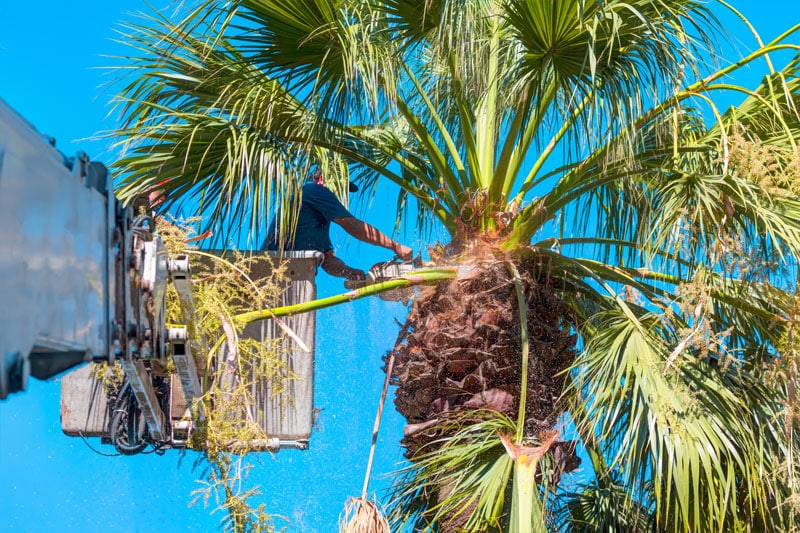
Because non-self-cleaning palms hold onto these dry, peeling boots, property owners often turn to a specialized cosmetic and functional maintenance process known as “palm tree skinning” (also sometimes called skimming).
Skinning involves a trained arborist or tree care professional carefully using specialized curved blades to slice away the dead, remaining boots from the trunk. This reveals the smoother, narrower, and cleaner-looking inner trunk tissue beneath.
Skinning is highly popular in Southern California not just for the sleek, manicured aesthetic it provides, but for critical pest control. The thick, peeling boots and dead frond skirts of a fan palm are notorious havens for roof rats, pigeons, scorpions, and other unwanted pests. By skinning the tree, you eliminate their habitat.
When is “Peeling” a Sign of Trouble?
While the shedding of old boots is a completely normal part of a palm’s lifecycle, there are times when trunk deterioration is a sign of a serious problem.
Because palms lack protective bark, any deep gouges from weed whackers, lawnmowers, or improper climbing spikes used by untrained trimmers remain permanent wounds. These wounds cannot heal over with bark like a normal tree. Instead, they become prime entry points for fatal pathogens.
According to the University of California Statewide Integrated Pest Management Program (UC IPM), several lethal fungal infections, such as Thielaviopsis trunk rot or Fusarium wilt, enter through these unprotected wounds. If you notice the trunk of your palm is oozing sap, feeling soft or spongy to the touch, or collapsing inward, this is not normal shedding—it is a sign of internal rot, and the tree may be at risk of sudden failure.
Keep Your Palms Healthy and Beautiful
Understanding the unique biology of your palm trees is the first step in proper landscape management. Whether your palms are naturally shedding their old frond bases or they need a professional touch to look their best and remain pest-free, routine maintenance is key to keeping them thriving in our beautiful, yet challenging, local climate.
If you are looking to enhance the safety and aesthetic appeal of your property, Rancho Landscape and Tree Care provides expert palm tree skinning, trimming, and removal services throughout the San Fernando Valley and the Greater Los Angeles area. Our highly experienced crews know exactly how to handle these unique monocots without causing the permanent damage that untrained workers often inflict. To schedule a consultation or request service for your property, please visit our Contact Us page today.